Particles and dissolved substances are different.
CDC explains that a filter’s behavior depends on pore size and on the size and electrical charge of the substance. One filtration method does not address every kind of water concern. [1]

Our story
Real Filter Media, Transparent Quality.
No Layer Tricks, Just Pure Results.
Water is part of your day long before you give it a second thought. The filter it passes through deserves a closer look.
The question behind our design
A shower before work. Hands washed between meals. Fruit rinsed at the sink. Small routines, repeated every day. Filtration belongs to that ordinary rhythm, even when the science behind it feels anything but ordinary.
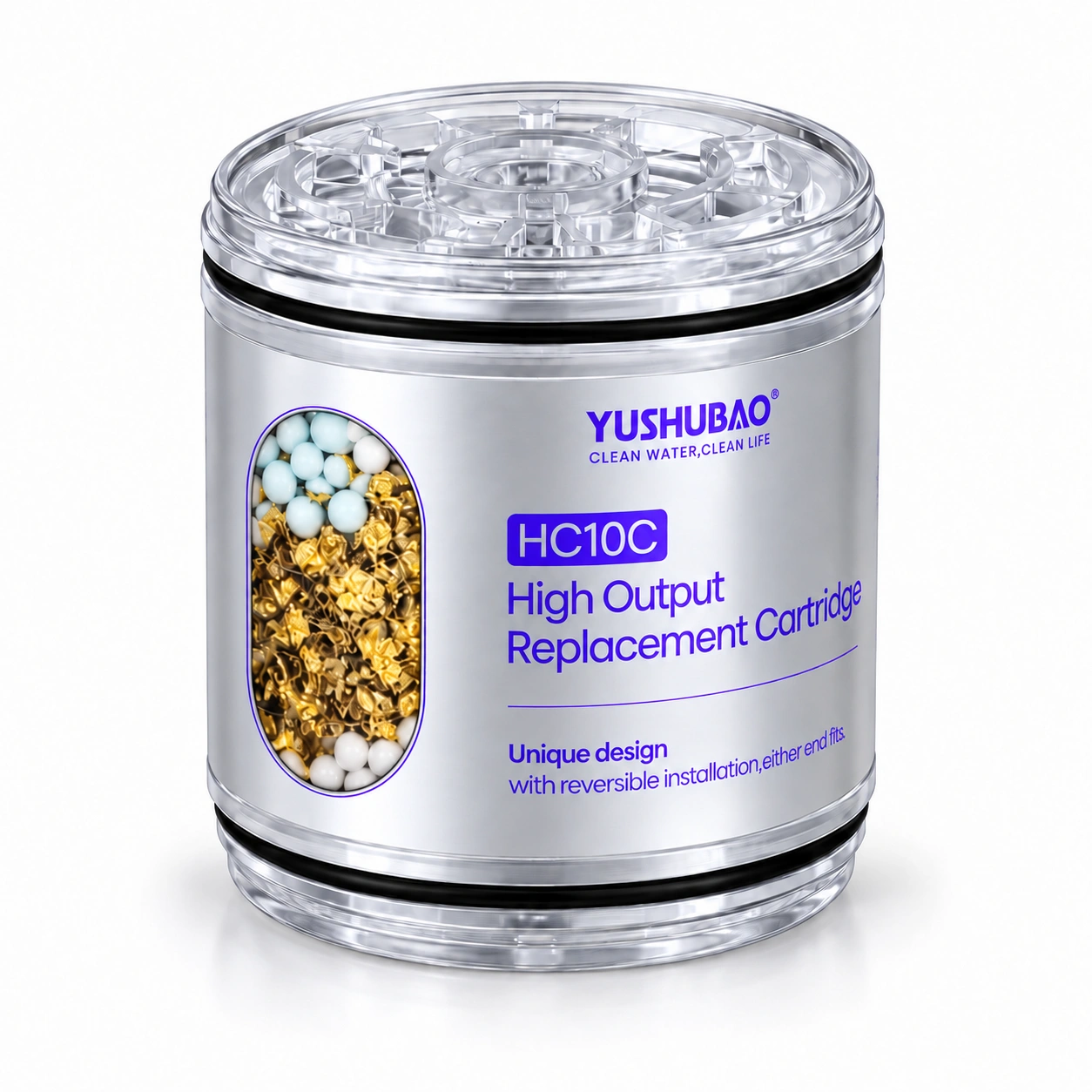
At YUSHUBAO, our starting point is the cartridge. We put our attention into the materials inside it, then give you a window to see them. Because the part doing the work should be part of the conversation.
A transparent housing cannot tell the whole story. It can make the product easier to understand. The rest takes clear specifications, useful instructions and evidence that matches the claim.
A little science. A clearer picture.
Filtration is more than a stack of layers. Different materials interact with different substances in water. Understanding those differences is a better starting point than counting stages.
CDC explains that a filter’s behavior depends on pore size and on the size and electrical charge of the substance. One filtration method does not address every kind of water concern. [1]
KDF® 55 is a copper-zinc medium. Its manufacturer describes an oxidation–reduction reaction: electrons are transferred, and free chlorine is converted to chloride ions. This is a material mechanism, not a count of physical layers. [2]
A cartridge is a replaceable part. CDC recommends maintaining filters and changing them according to the manufacturer’s guidance. Regular care belongs alongside material choice when you choose a filter. [1]
General material science from the media manufacturer [2]. The diagram does not show a removal percentage or establish the performance of a finished YUSHUBAO filter. Chloride and free chlorine are chemically different; this process does not mean all dissolved salts are removed.
Look closer. Ask better questions.
Transparency makes the inside visible. Testing answers a different question: how a particular filter performs under stated conditions.
| What you notice | What it tells you | What to look for next |
|---|---|---|
| A clear housing or viewing window | You can see the media and the cartridge’s construction. | Material identification and model-specific performance information. Appearance alone cannot verify water safety. [1] |
| A headline stage count | How the design is described. | Which substance is targeted, under which conditions, and how the result was measured. |
| An identified filter medium | A starting point for understanding its mechanism. [2] | Evidence for the complete filter, rather than treating a media supplier’s result as a finished-product result. |
| A capacity or replacement interval | Guidance for planning maintenance. | The model, water conditions and replacement instructions. A capacity number is not a contaminant-removal percentage. |
| A certification claim | A reference to an independent standard, when verified. | The exact model and listed reduction claim. NSF/ANSI 177 covers shower filtration and aesthetic free available chlorine reduction. [3] |
Sources [1]–[3] provide general background. Mentioning a standard here is not a claim that YUSHUBAO products hold that certification.
Our choices, made visible
Our promise starts with how we present the product: show the core, explain its purpose and make it easy to care for.
01 / Materials come first
We focus on the media inside the cartridge. Our faucet filter specification lists KDF 55, calcium sulfite and scale-control balls. Each material deserves a clear description of its role.
We prefer that conversation to a dramatic layer count. The amount of media matters to a design, but more material alone is not proof of better performance.
02 / Give it a window
Our cartridge housings are transparent. The shower cartridges use silver sleeves with viewing windows. The faucet cartridge has a clear label with a white logo.
The window lets you see what is inside. Color and appearance do not measure remaining capacity, so we pair that visibility with replacement guidance.
03 / Make care clear
Every filter family has a matching cartridge. Our illustrated guides show how to fit it, flush it and replace it.
Good instructions make the technical details useful: a recognizable model number, a clear replacement schedule and a core you can change.
Plan the next replacement
These are YUSHUBAO’s stated maintenance references, shown separately from the scientific background above.
| Filter model | Cartridge | Stated capacity reference | Replacement interval |
|---|---|---|---|
| HC101 | HC10C | 12,000 US gallons (approx. 45,400 L) | 3–4 months |
| HH901 | HH90C | 6,000 US gallons (approx. 22,700 L) | 3–4 months |
| FS801 | FS80C | 8,000 US gallons (approx. 30,300 L) | 3–4 months |
| FF201 / FF202 | FF20C | 6,000 US gallons (approx. 22,700 L) | 3–4 months |
Source: supplied YUSHUBAO product information and current replacement guidance. Replace at 3–4 months or the stated water volume, whichever comes first. Water quality and use may require earlier replacement. Liter values are approximate conversions from US gallons. These figures are not independent laboratory results or a guarantee of contaminant reduction across the stated volume.
The YUSHUBAO approach
Filtration can be technical. Choosing and caring for a filter should feel clear.
That is the story we want every window, every cartridge and every instruction to tell.
Read the background
Filter selection, pore size, limits of visual assessment and maintenance.
Media manufacturer’s explanation of copper-zinc media and redox chemistry. Supplier information is not a YUSHUBAO product test.
Scope of the shower filtration standard and verification of model-specific certification claims.
Need help choosing a filter or replacement cartridge? Just ask.